Map of the Portuguese settlements in Africa and America around 1600.
Map of the main Portuguese settlements in the East (1600s.).

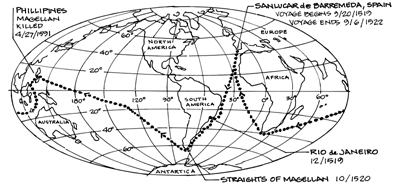
Ferdinand Magellan (c.1480-1521) was a Portuguese sea captain who launched an expedition funded by Spain to find a new route to the Spice Islands, north of Australia. Magellan is credited with leading the first expedition to circumnavigate the globe, but he didn't live to complete his journey. After weathering storms, several mutinies, animosity between Portuguese and Spanish crew members, and near starvation when they were forced to eat rats, ox hides, and sawdust, they landed in the Philippine Islands. Although they were welcomed there by the natives, Magellan became involved in local politics and was killed in a battle between two rival factions of Filipinos on Mactan Island.
Magellan discovered the passage between the Atlantic and the Pacific Oceans at the tip of South America, which became known as the Straits of Magellan. As he passed through the straits, he and his crew became the first Europeans to sail into the "new" ocean. Magellan named it Pacific (which means peaceful) because it appeared calm after the stormy Atlantic. In reality, the Straits of Magellan and the Pacific Ocean are noted for their high winds, giant waves, and violent weather.
It took Magellan's crew three years to complete their voyage, while today it takes a satellite about 100 minutes to circumnavigate the globe.
Vasco da Gama is famous for his completion of the first all water trade route between Europe and India. Da Gama’s father, Estavao, had originally been chosen by King Joao II to make this historic voyage, but he died before he could complete the mission. Vasco da Gama was born in Sines, Portugal in 1469. Da Gama also served as a navel officer, and in 1492 he commanded a defense of Portuguese colonies from the French on the coast of Guinea. Da Gama was then given the mission to the take command of the first Portuguese expedition around Africa to India. When Vasco da Gama set out on July 8, 1497 he and his crew planned and equipped four ships. Goncalo Alvares commanded the flagship Sao (Saint) Gabriel. Paulo, da Gama's brother, commanded the Sao Rafael. The other two ships were the Berrio and the Starship.On the voyage, da Gama set out from Lisbon, Portugal, rounded the Cape of Good Hope on November 22, and sailed north. Da Gama made various stops along the coast of Africa in trading centers such as Mombasa, Mozambique, Malindi, Kenya, and Quilmana.Vasco da Gama finally arrived in Calicut, India on May 20, 1498. Calicut was the principle market of trade for precious stones, pearls, and spices. At first, the Portuguese were well received and accepted by the Hindu ruler. There was a great ceremony, and da Gama was taken to a Hindu temple. Vasco da Gama and his crew departed in August 1498 and reached Lisbon in September of 1499. The return trip took so long because many of the sailors died of diseases such as scurvy. When Vasco da Gama returned, he was rewarded with a great celebration. Da Gama was looked upon as a hero, and King Manoel awarded him with titles and a large income.
When Vasco da Gama went out on his second expedition on February 12, 1502, he was prepared for an encounter with the Muslim traders. He set sail with 20 well-armed ships, hoping to force his way into the market and to get revenge on the Muslims for the opposition in 1498. When da Gama arrived in Calicut on October 30, 1502, the Zamorin was willing to sign a treaty. Da Gama told him that he would have to banish all of the Muslims. Later da Gama bombarded the city with guns and forced his way into the trading system. This led the way for other Portuguese conquests in the East Indies. In February of 1503, da Gama returned home. During his final voyage to India, da Gama got sick and died on December 24, 1524. Vasco da Gama's remains were taken back to Portugal, where he was buried in the chapel where he had prayed before his first voyage.
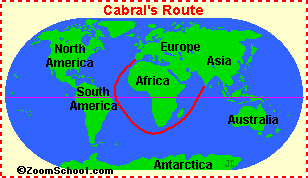
Pedro Álvares Cabral (1467-1520) was a Portuguese nobleman, explorer, and navigator who was
the first European to see Brazil (on April 22, 1500). Cabral's patron was King Manuel I of Portugal,
who sent him on an expedition to India. Cabral's 13 ships left on March 9, 1500, following the route
of Vasco da Gama. On April 22, 1500, he sighted land (Brazil), claiming it for Portugal and naming it
the "Island of the True Cross." King Manuel renamed this land Holy Cross; it was later renamed once
again, to Brazil, after a kind of dyewood found there, called pau-brasil. Cabral stayed in Brazil
for 10 days and then continued on his way to India, in a trip fraught with storms, shipwrecks
(at the Cape of Good Hope), and fighting (50 of Cabral's men were killed after an attack from
Muslim traders in Calicut, India, who did not want competition on their spice routes).
Cabral successfully traded for spices in Cochin (now called Kozhikode), India (in early January, 1501).
Cabral returned to Portugal on June 23, 1501, with only four of the original 13 ships.
More at http://www.d23.org/sullivan/travis/Explorer%20Book/Cabral.htm.
Diogo Cão Portuguese navigator, he was sent twice (1482 and 1484) to the Discoveries by
D. João II.
He set off to Mina, and from there he went to Zaire. After a series of vicissitudes, he reached
"ponta dos Farilhões" (sierra Parda), at 22° 10', South latitude, and then returned to Zaire,
which he climbed, to visit the king of Congo.
He returned to Tagus river in 1486, bringing with him the necessary knowledge to reach South
Africa by sailing at large, like Vasco da Gama did.
some caps:
Bartolomeu Dias (Cap de Bonne-Espérance) fut tout d'abord gentilhomme à la cour du roi du Portugal Jean II où il exerçait la charge d'intendant des magasins royaux. Il put y fréquenter des hommes de sciences et les navigateurs partis découvrir la côte ouest de l'Afrique, dont le célèbre cosmographe allemand Martin Behaim qui l'initia à son art. Il participa aussi à l'expédition de 1482 au cours de laquelle fut fondé le comptoir de La Mine (situé dans l'actuel Ghana). La solide réputation qu'il avait acquis décida Jean II à lui confier le commandement d'une expédition qui devait poursuivre plus au sud les expéditions de Diogo Cão (1484) et de d'Aveiro (1486) qui s'étaient arrêtées au Congo. La flotte quitta Lisbonne en août 1487 et atteignit le Congo en un peu moins de quatre mois. Mais les vents de l'hémisphère sud sont inversés par rapport à ceux de l'hémisphère nord, et la flotte peina à louvoyer. Finalement, Dias décida de laisser derrière lui la lourde nef particulièrement lente avec 9 hommes pour la garder et parti chercher les vents d'ouest plus au sud. Il mis ensuite cap à l'est. Puis, ne voyant poindre aucune terre, il retourna un peu au nord. C'est alors qu'il fut pris dans une tempête providentielle qui le ramena près de la côte où il aperçut les hautes montagnes de la baie Mossel où il débarqua : il venait de passer la pointe sud de l'Afrique, qu'il baptisa ainsi "Cap des tempêtes" (et qui fut ensuite renommé "Cap de Bonne-Espérance" par Jean II). Dans la foule venue les accueillir se trouvait un jeune gênois paradoxalement moins joyeux. Il s'agissait de Christophe Colomb qui était revenu une deuxième fois à Lisbonne proposer ses services au roi Jean II. Il comprenait qu'il serait désormais très difficile de défendre son projet d'une route des Indes par l'ouest. A son arrivée, Dias fut couvert d'honneur. Cependant, des problèmes de politique intérieure et la menace d'une guerre avec l'Espagne retardèrent la décision d'une nouvelle expédition. En 1494, le traité de Tordesillas fixa une ligne de démarcation entre les terres attribuables aux deux pays. L'année suivante, Jean II décida d'aller jusqu'en Inde et confia le commandement d'une flotte au jeune Vasco de Gama, Dias n'étant à la tête que d'un modeste navire. Mais le roi mourrut peu après et le départ n'eut lieu qu'en 1497.
En 1500, Dias repartit pour les Indes sous la direction de Pedro Alvares Cabral.
Mais il périt au large du cap de Bonne-Espérance lors d'une tempête qui engloutit quatre navires de
l'expédition.
More at http://www.publius-historicus.com/dias.htm.
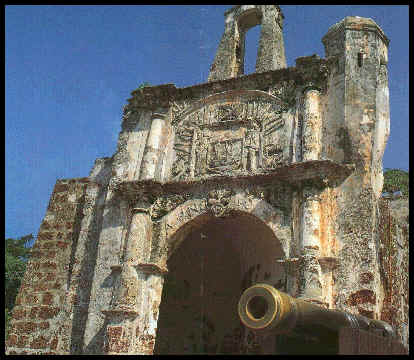
Maybe you go to Malacca:
Check out http://www.geocities.com/Athens/Styx/6497/malacca.html.
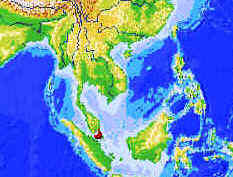
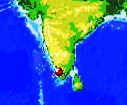
Maybe you go to Ceylan, Goa ou Cochim en Inde
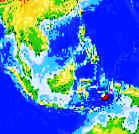
Maybe you go to Lesser Sunda islands (Ternate, Moluccas or Timor):
East Timor – Republic in Maylay Archipelago: capital, Dili. After four centuries of Portuguese colonial rule, 26 years of occupation by Indonesia, and three years of governance by the United Nations, East Timor celebrated its independence on 19 May 2002, the first new state to be born in the new millennium. Diplomatic relations have been established with the Vatican, at the level of apostolic nunciature on the part of the Holy See and of embassy on the part of the Democratic Republic of East Timor. Of the total population of 737,811, 91% are Catholic.
http://www.geocities.com/Athens/Styx/6497/ternate.html.
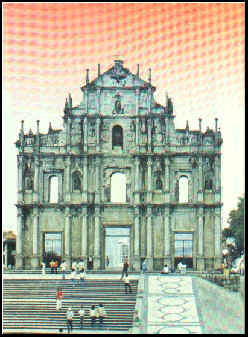
Maybe you go to MACAU in China: